Updated 4/22/2024
Pre-service teachers have the advantage of being students while beginning to understand the world of education.
I view this dual role as advantageous because it largely inspires my teaching philosophy. Not only do I have foundational beliefs about education from my recent experience working with students, but I can also draw on my recent experiences as a student impacted by such philosophies.
Oftentimes, I find that what most excites me about becoming a teacher is replicating or changing what my teachers have done for me. With this, my teaching philosophy can be broken down into various categories that all together encompass what I believe to be the goal of education.
- Critical thinking is the most important cognitive skill taught in school.
A common complaint amongst [older] students is that they “will never need to use this” in the real world. I will discuss the importance of students understanding the “why” behind lessons in the next section. Until then, I’d like to refute this complaint by suggesting that the cognitive skills acquired during lessons can be more important than the content itself.
Critical thinking is defined as “the objective analysis and evaluation of an issue in order to form a judgment.”
The breadth of this definition proves its importance. Every single decision we make relies on our ability to analyze evidence.
Pertaining my future as an English teacher, a common example of critical thinking in my class will be analyzing texts. Understanding the purpose of writing and expressing it in your own words translates to every email, journal, or procedure my students will use in their life outside of English class. I therefore view it as my duty as a future teacher to frequently hit the higher levels of Bloom’s taxonomy (analyze, evaluate, and create) in order to build my students’ critical thinking muscles because of their highly transferable nature.
I recognize that these higher order thinking skills require background knowledge. After all, thinking is the process of combining information in new ways. Thus, I highly value ensuring that students have enough relevant background knowledge to be successful. For example, a student cannot write an essay that demonstrates understanding of the themes of a text if they don’t understand the structure of an essay itself. Further, it cannot be assumed as prior knowledge that essays require in-text citations. This would prevent students from exemplifying what they know, as their comprehension might get lost in the poor structure of an essay.
This principle includes my promise to understand that every student comes in with different experiences, needs, and skills. I vow to meet students where they are in this regard.
- Students need to care about what they are learning.
At first glance, this might seem more of a responsibility for students rather than teachers. However, we as educators cannot expect students to have an inherent hunger for knowledge. We know that intrinsic motivation for learning will yield the best results and relationship with education.
Some students have this natural liking for school, but what are teachers expected to do for those who don’t?
They certainly shouldn’t cut their losses. It becomes the teacher’s responsibility to provide a fun, positive learning environment.
Games are an excellent example of a fun, engaging activity that gets most students active in their learning. Educational review games have the potential to eliminate the bias some students have against school in general by giving them a new aspect to care about: winning.
In addition, intensive, longer games as pedagogical tools still offer great methods of assessment while increasing the likelihood of engaged students. For example, John Hunter’s World Peace Game has fourth graders create world peace by placing them in hyper-realistic political scenarios. Taking place over the course of weeks, an educator can collect valuable data by way of observation. Many of these games are also deeply collaborative, which targets those life skills and caters to interpersonal learning styles.
I never saw my Spanish class during senior year of high school more engaged than when we played Quizlet live to learn our vocabulary. Every single student participated via teams, competing for candy. It no longer mattered that we were new adults, preoccupied with college applications, or generally unmotivated; we could have fun while doing something mandatory either way. I heavily endorse this approach.
Games are just one pedagogical tool that help educators nail the balance of difficulty and engagement in their classroom.
Thinking is not a natural process. Even in the best case when students are curious about content matter, teachers cannot rely on content to drive interest in classroom activities. This is why I believe it is important to scaffold appropriate problem solving opportunities—like Hunter’s game does—to our students. Problem solving brings pleasure and a sense of accomplishment, but must be challenging within reason. I am committed to forever chasing this balance.
Further, students are unlikely to be intrinsically motivated if they don’t understand the purpose behind what they are learning. It is natural in my opinion to question why something deserves to have time spent on it. Learning objectives and goals should be available to students, in language they can understand, for this reason. It might not guarantee that students will care about the lesson, but it guarantees that their time isn’t being wasted. As a student, I greatly appreciate that and will treat it as my future students’ right.
- Teachers need to support students emotionally.
In addition to providing opportunities for engagement, I believe in the importance of providing opportunities for students to develop social, emotional skills as well. Outside of sports, school is the largest opportunity for students to interact with other kids their age.
Learning how to work in a group is just as important for social development as critical thinking is for cognitive development.
Because of this, I am a strong believer in occasional team presentations, review games, and group discussion. The emphasis during any of these learning activities should be about prioritizing learning over performance.
Supporting students emotionally also looks like being their cheerleader. Home lives can be painful and complicated, so empathy goes a long way. Even when students have a healthy home environment, encouragement from a teacher can build confidence and worth.
For example, I was told that two of my teachers had nominated me for an English department award. I hadn’t won the award, but my teachers made it a point to tell me of the nomination to prove how much they believed in my abilities. Clearly, since I am writing about it now, it had a lasting impact in my life. I vow to express my confidence in my students and root for them in all things. I cannot control what happens at home, but I can control the atmosphere of my classroom.
- Curriculum should guide what is taught, while leaving room for how it is taught.
Because this opinion can be controversial, I want to preface by stating my understanding about the purpose of curriculum. It establishes a plan that keeps teachers accountable. Curriculum also serves to maintain consistency between teachers in a school or district. This is important for guaranteeing students equal access to quality education.
However, all students learn differently. I absolutely think teachers should use curriculum with this understanding. I also believe that it is important to constantly review and adapt one’s practices in order to best serve students.
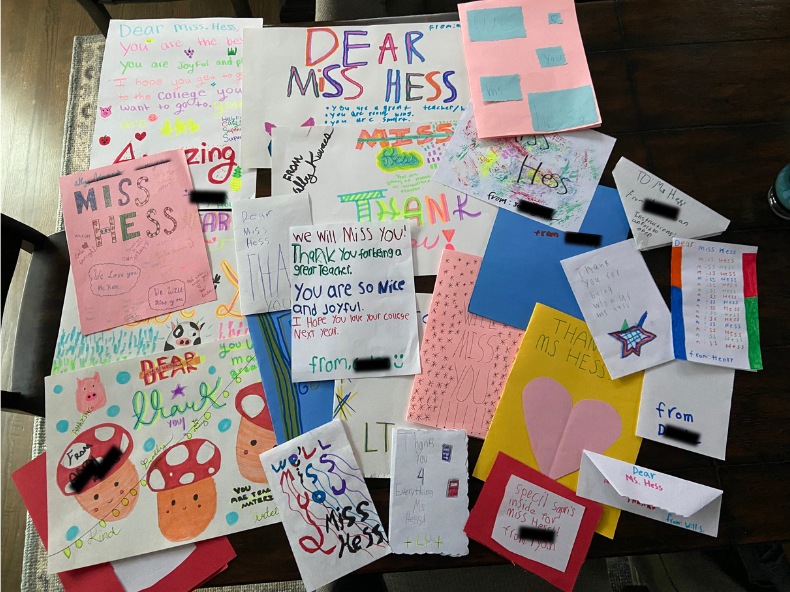
I so firmly believe this due to my experience in the village project. My student has a lot of energy during tutoring time, and he mentioned early on how much he loves sports. When I noticed him drifting away– mentally and physically– I decided to adapt my activities by incorporating movement.
What I teach stays the same as given in my lesson plan, but how I teach him is catered to this individual need for movement.
Specifically, instead of practicing our high-frequency words at a desk flashcard style, I lay the cards out on the floor and instruct him to jump on the word “got” and so on. My given curriculum provides content and strategies, but it is not exhaustive. As a teacher, I will brainstorm creative ways to connect with my students according to their needs as individuals and as a group that varies year to year, or even by class period.
